
Giving gold or silver this holiday season: a practical guide
How to choose a metal, a size and a format for a gift of gold or silver, and what to check on the label.
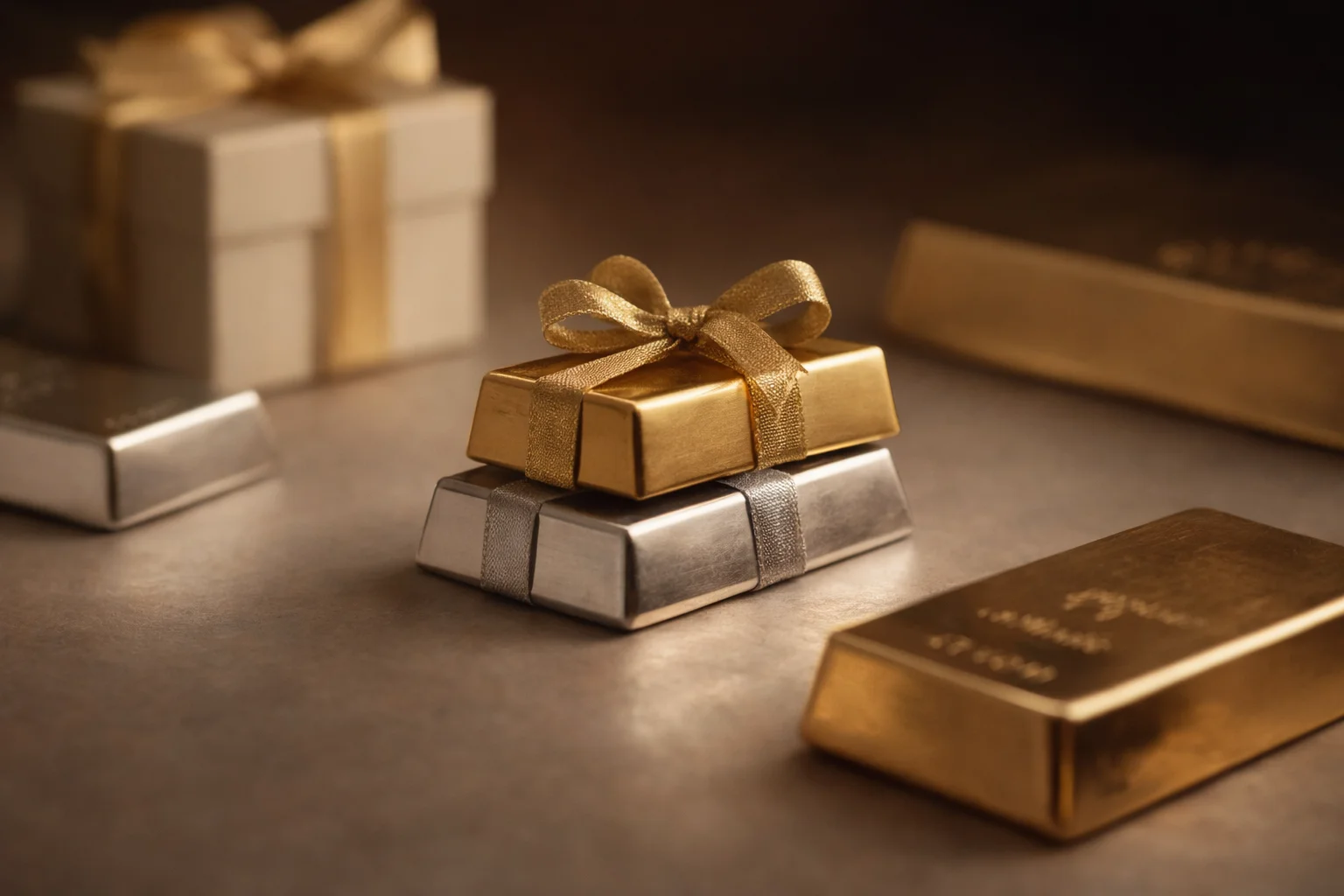
A gift of gold or silver is valued for what it is made of, which sets it apart from most things bought in December. It is also easy to get wrong. Two pieces that look alike in a listing can differ in weight, purity and packaging, and those differences decide what the recipient actually holds.
The first choice is the metal. Gold concentrates value in a very small object, so even a gram-sized bar is a complete piece. Silver gives a larger, heavier coin or bar for a similar outlay, which many recipients find more satisfying to hold. Platinum is less common in gift buying and tends to suit someone who already owns gold or silver.
The second choice is size. Gold is no longer sold only in ounce units. Refiners such as Valcambi, PAMP, Argor-Heraeus and the Perth Mint produce carded gold bars from half a gram upward, in steps of 1, 2.5, 5, 10 and 20 grams. Multigram formats such as the Valcambi CombiBar combine many 1 gram units in one bar. Sovereign mints cover the same small sizes in coin form, with fractional pieces such as the 1/10 ounce American Gold Eagle and the 1/20 ounce Gold Maple Leaf.
Coin, bar and the card
Coins and bars answer different tastes. A coin from a sovereign mint carries a national design, a face value and a year, which gives it a story. A bar from a private refiner is plainer and is described almost entirely by its weight, fineness and maker. Neither is more genuine than the other.
Most small bars are sold sealed in an assay card that states the refiner, the weight and the fineness, and often a serial number. The card protects the bar and keeps its details with it. Opening it does not change the metal, but a sealed card is simpler to verify when the bar is later stored or sold, so it is usually best left closed.
Reading the label
Three details on a listing deserve a second look. The first is the unit. Precious metals are measured in troy ounces of about 31.1 grams, not the 28.35 gram ounce used for everyday goods, so a 1 gram bar is listed at 0.0322 troy ounces and a 1 kilogram bar at 32.1507.
The second is fineness. Most gold bars are .9999, or 99.99 percent gold. Some coins are not: the American Gold Eagle is 22 karat, .9167 fine, with the balance in harder alloy metals. The coin's stated weight refers to its gold content, so a 1/10 ounce Eagle still holds a tenth of an ounce of gold.
The third is the year. Coins listed as "year varies" ship with whichever mint year is in stock. For a gift tied to a birth year or an anniversary, a listing that names the year is the one to choose.
What to watch, then, is the description rather than the photograph: the unit of weight, the fineness, the packaging and, for coins, whether the year is fixed. Those four details tell a buyer exactly what the gift contains.
Sources: LBMA, A Guide to the Loco London Precious Metals Market, chapter 18, Conversion Table (https://www.lbma.org.uk/publications/the-otc-guide/conversion-table); Summit Bullion product listings for gold bars, the 1/10 oz American Gold Eagle and the 1/20 oz Gold Maple Leaf (https://www.summitbullion.io/marketplace?metal=Gold).
This article is general information, not investment advice. Facts from other publications are their reporting, linked above.